The easiest way to store food containers and lids in a small kitchen is to nest matching shapes and file lids upright nearby. Good food container storage leaves enough room to remove one piece without emptying the cupboard.
You don’t need a matching collection or another cabinet. We recommend starting with the containers you use, then arranging them around your available space. First, give yourself a manageable sorting area without taking over the counter you need for cooking.
Key Takeaways
- Match containers with their lids before deciding how much storage space you need.
- Nest compatible shapes, keep everyday pieces accessible, and store lids where you can see their edges.
- Try an existing basket or divider before buying an organizer, and leave room to remove everything comfortably.
Start With the Containers You Use
Empty one container drawer or cupboard rather than spreading the whole kitchen across your counters. Bring in matching pieces from the drying rack so your decisions reflect what you own.
Match Every Lid Before Sorting
Fit lids onto their containers instead of judging by appearance. Similar-looking lids can belong to different sets, so matching them now prevents repeated searching later.
Separate complete pairs from loose pieces. Set unmatched items aside while you finish sorting, then look for their partners before returning them to storage.
Remove damaged pieces and sizes you never reach for. Recycle or discard them according to local guidance. Don’t let an unused collection determine how much cupboard space your everyday containers receive.
Keep Enough for Your Routine
Base your collection on your meals and washing schedule. If you pack lunches while leftovers occupy other containers, your storage needs differ from someone who cooks single portions.
Keep useful shapes rather than automatically keeping every piece in a set. Shallow containers deserve a place if you regularly save cooked food. The USDA’s Food Safety and Inspection Service (FSIS) recommends dividing leftovers into shallow containers for faster, more even cooling.
Meanwhile, move occasional-use containers behind your everyday group, provided you can still retrieve them easily.
Choose a Home for Food Container Storage
Choose the location before buying organizers. A convenient drawer or accessible cupboard usually works better than a distant shelf with more capacity.
Use a Drawer for a Clear View
A drawer lets you see containers and lids from above. Keep nested bases in one area and upright lids beside them, rather than letting loose lids slip underneath stacks.
Measure the usable interior, including any space lost to drawer hardware. Also account for the height of upright lids when the drawer closes.
Our guide to choosing deep drawer organizers explains how to assess usable space before adding inserts. For this job, start with the largest container and lid you plan to keep there.
Make a Cupboard Easy to Reach Into
In a cupboard, place everyday containers near the front. A removable basket can bring smaller pieces forward together, especially when the shelf is deep.
However, avoid putting one frequently used group behind another. You’ll soon end up leaving the front group on the counter to reach what’s hidden.
If containers share a cupboard with dinnerware, give each category a clear area. Our approach to organizing plates and bowls can help you separate those groups without making dish stacks taller. Keep the heaviest pieces where you can lift them comfortably.
Nest Containers Without Building an Awkward Tower
Nest containers that fit together naturally, with larger bases underneath smaller ones. Separate different shapes so you don’t have to balance an uneven pile.
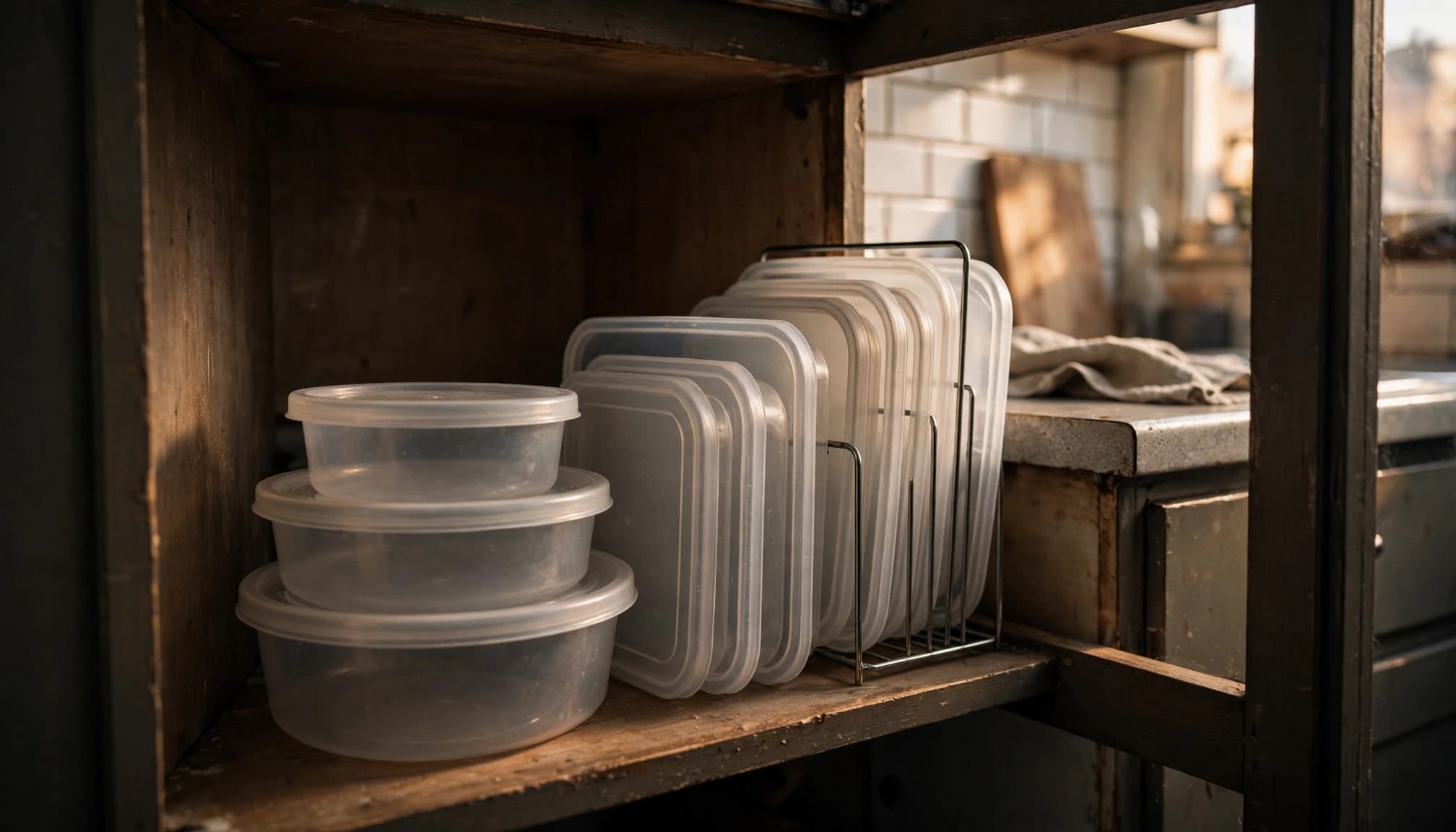
Don’t force one container into another. If pieces wedge together, store them in separate stacks. Saving a little shelf space isn’t useful when pulling them apart becomes a daily struggle.
Keep the most-used size accessible. If you repeatedly lift several containers to reach it, create a separate short stack rather than keeping everything nested together.
Leave space above each stack for your hand. A stack can fit beneath a shelf but still be awkward to lift out, especially at the back of a cupboard.
When a large container holds smaller ones, make sure those smaller pieces remain easy to identify. Avoid turning the largest base into a catchall for unrelated lids and accessories.
A useful nesting arrangement passes two tests: you can take out the size you need, and you can return it without rebuilding the cupboard.
Store Lids Upright Beside Their Containers
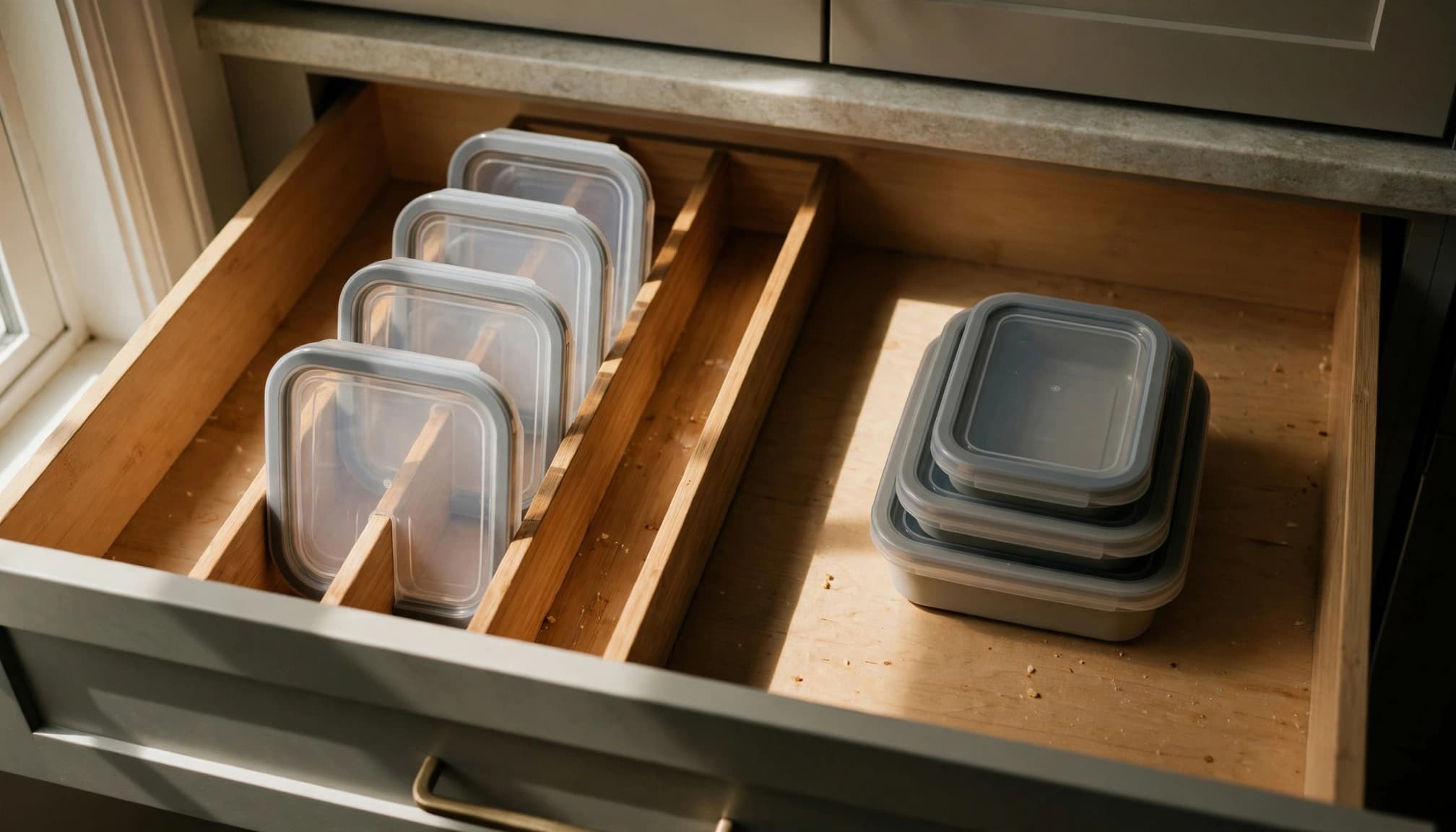
Upright storage makes lid edges visible and prevents a flat pile from sliding apart. Keep the lid group beside its matching bases whenever the space allows.
File Lids by Shape and Size
Use a narrow washable basket, a suitable freestanding rack, or a divided section of your drawer. The organizer only needs to keep lids upright and stop them spreading.
Group similar shapes together, then arrange them by size. This makes choosing a lid easier without requiring a separate compartment for every piece.
Keep small lids in a section where they won’t disappear beneath larger ones. If upright storage doesn’t suit them, a shallow tray beside the main lid group works well.
Leave Enough Room to Browse
Avoid packing lids so tightly that removing one pulls out the whole row. You need enough room to separate the edges and grasp the lid you want.
Before settling on the arrangement, remove your largest lid and return it with everything else in place. Then close the drawer or cupboard.
For door-mounted storage, consider both the door’s movement and the shelf behind it. An organizer that fits an open door can still collide with the cupboard contents when closed.
Buy One Organizer for One Clear Problem
The best small kitchen storage purchase solves an inconvenience you’ve already identified. Start with a basket or tray you own, then replace it only if the trial reveals a clear limitation.
Match the organizer to the problem rather than buying a complete system.
| Storage problem | Simple option | Space to allow |
|---|---|---|
| Lids slide into a pile | Freestanding lid rack | Room between lids and above them |
| Small pieces disappear in a drawer | Removable divider or shallow tray | Clearance beneath the closed drawer |
| Containers vanish at the back | Washable pull-forward basket | Room to pull it out and lift it |
Choose the smallest addition that makes access easier. An organizer with thick sides or many compartments can consume space your containers need.
For renter-friendly storage, loose inserts and freestanding racks avoid permanent changes. Our no-drill storage ideas cover other ways to use existing cupboards without installing fixtures.
Before buying, measure the organizer’s outside footprint and usable interior. Also consider how you’ll clean it. A simple tray that lifts out easily may suit your routine better than an elaborate rack.
Our Top Recommendation: RubberMaid EasyStore Containers. Stackable, microwave safe, dishwasher safe, highly rated and available from a starter 4 piece set all the way to a 44 piece set if needed.
As of the time of this writing, the 18 piece set is on an “early Black Friday” deal at 33% off. Even when these aren’t on “big” sales, they are still very reasonably priced. But I like to get a sales deal when I can 🙂
If you need something a little more ‘on the go’, we recommend checking out the Dealusy 50 pack Meal Prep containers. I got these as an easy way to bring lunch to work. And if you are doing meal prep, these are great containers for a full week of food storage in the fridge. Highly rated, freezer and dishwasher safe and available from 24oz up to 38oz.
Make Putting Containers Away Easy
Small-space organization lasts longer when returning an item takes little effort. Leave some breathing room for containers coming back from the dishwasher or drying rack.
Store Everything Clean and Dry
Let containers and lids dry completely before nesting or putting them away. Pay attention to rims and grooves where water can collect.
Keep the empty-container area separate from food that needs chilling. Once containers hold leftovers, refrigerator conditions matter. FSIS guidance on safe refrigerator storage temperatures calls for 40 degrees Fahrenheit or below.
Keep cleaning supplies outside this storage area so clean food-contact surfaces don’t share space with leaking bottles.
Reset While You Put Dishes Away
Return each lid to its group and each base to its stack. If several people share the kitchen, simple labels such as “Lids” and “Containers” can clarify the arrangement.
Notice what repeatedly ends up beside the organizer instead of inside it. A basket may be too narrow, or a stack may take too much effort to rebuild.
Adjust that problem before adding more storage. A workable apartment organization system should accommodate normal use, including the day every container is clean at once.
Frequently Asked Questions
Should You Store Containers With Their Lids On?
For everyday containers, separating lids usually allows bases to nest and use less cupboard space. Keeping lids attached can suit an occasional-use container when finding its partner would otherwise be difficult.
Use both methods if that fits your collection. Store pieces clean and completely dry, and avoid keeping every container assembled when empty space is limited.
How Do You Organize Container Lids Without Buying Anything?
Try a washable basket, shallow tray, or spare divider you already own. Stand larger lids upright when the sides support them, and give tiny lids a separate section.
Test the arrangement through ordinary use before buying anything. If lids remain visible and you can remove one easily, an existing container may be all you need.
What If You Have Almost No Spare Cupboard Space?
Reduce unused pieces first, then reassess the storage around your containers. Moving occasional-use serving dishes can free a convenient section without taking over another room.
You can also divide one drawer between lids and another useful category, provided both remain accessible. Avoid using the food-preparation counter as permanent overflow, since that makes a compact kitchen harder to cook in.
Keep Your Container System Simple
Useful food container storage gives each base and lid an easy place to return. A smaller, accessible collection is easier to manage than a cupboard packed with pieces you rarely use.
Start with one shelf or drawer, match what belongs together, and test the arrangement before spending money. Keep easy access as your measure of success, especially when every cupboard has to work hard.
We only recommend top-rated, affordable products you can trust. As an Amazon Associate, I may earn from qualifying purchases through the affiliate links above at no extra cost to you. Thank you for supporting our work.