Store sports equipment in a small apartment by keeping everyday gear accessible, using vertical space safely, and moving seasonal items into dry, covered storage. Good sports equipment storage starts with what you use. Space-saving storage keeps everyday gear accessible without crowding the room.
You don’t need a garage-sized rack to keep balls, bikes, and workout gear organized. Start with your available space, then choose storage that keeps your usual walking routes clear.
Key Takeaways
- Measure your equipment, storage space, and the clearance needed to retrieve each item.
- Use bins, mesh bags, and suitable freestanding organizers before adding permanent wall systems.
- Clean and fully dry equipment before storing it, especially inside closed containers.
Plan Around Your Gear and Daily Routine
Measure Equipment and Access Space
Gather your equipment by sport. Separate regular-use items, seasonal equipment, and anything you no longer need.
Measure your largest items first, including bicycle handlebars, racquet cases, and golf bags. Then measure usable storage width, depth, and height. Include the space needed to open doors, remove lids, and lift equipment out.
Tape a proposed rack’s footprint onto the floor. Walk past it carrying your usual bags before buying anything. Include the door swing and any radiator clearance, since an empty corner may still be unsuitable for storage.
Give Everyday Gear the Easiest Spot
Keep running shoes, a helmet, or your regular gym bag near the entrance. Occasional equipment can use higher shelves or under-bed space.
For entryway storage, contain only what you need for your next outing. Our guide to small entryway storage benches offers options when you also need somewhere to sit.
Leave room for returning equipment. A system becomes frustrating when putting one item away means moving several others.
Which Sports Equipment Storage Fits Your Gear?
Match the organizer to the equipment’s shape and how often you use it.
| Equipment | Compact Storage Option | Main Buying Consideration |
|---|---|---|
| Basketballs and soccer balls | Mesh bag or narrow open bin | Easy access without balls escaping |
| Racquets and bats | Divided upright bin or wall holders | Enough height and handle clearance |
| Bicycle | Vertical mount or freestanding stand | Bike weight and handlebar projection |
| Skis and snowboards | Padded wall rack or protective case | Dry location and secure support |
| Yoga mats and resistance bands | Slim basket and divided pouch | Ventilation and easy retrieval |
| Golf bag | Stable corner stand or dedicated rack slot | Full bag footprint and removal space |
| Home gym equipment, such as dumbbells | Low, stable tray or rack | Support rated for the load, with room to pick up and return weights safely |
Choose the smallest format that holds your current equipment comfortably. A rack with unused compartments can waste more space than separate containers.
Clear storage bins help you see small accessories. Add descriptive labels to opaque containers, especially when several sports share one shelf. Keep pumps and repair supplies beside the equipment they support.
How Can You Store a Bike Without Blocking the Room?
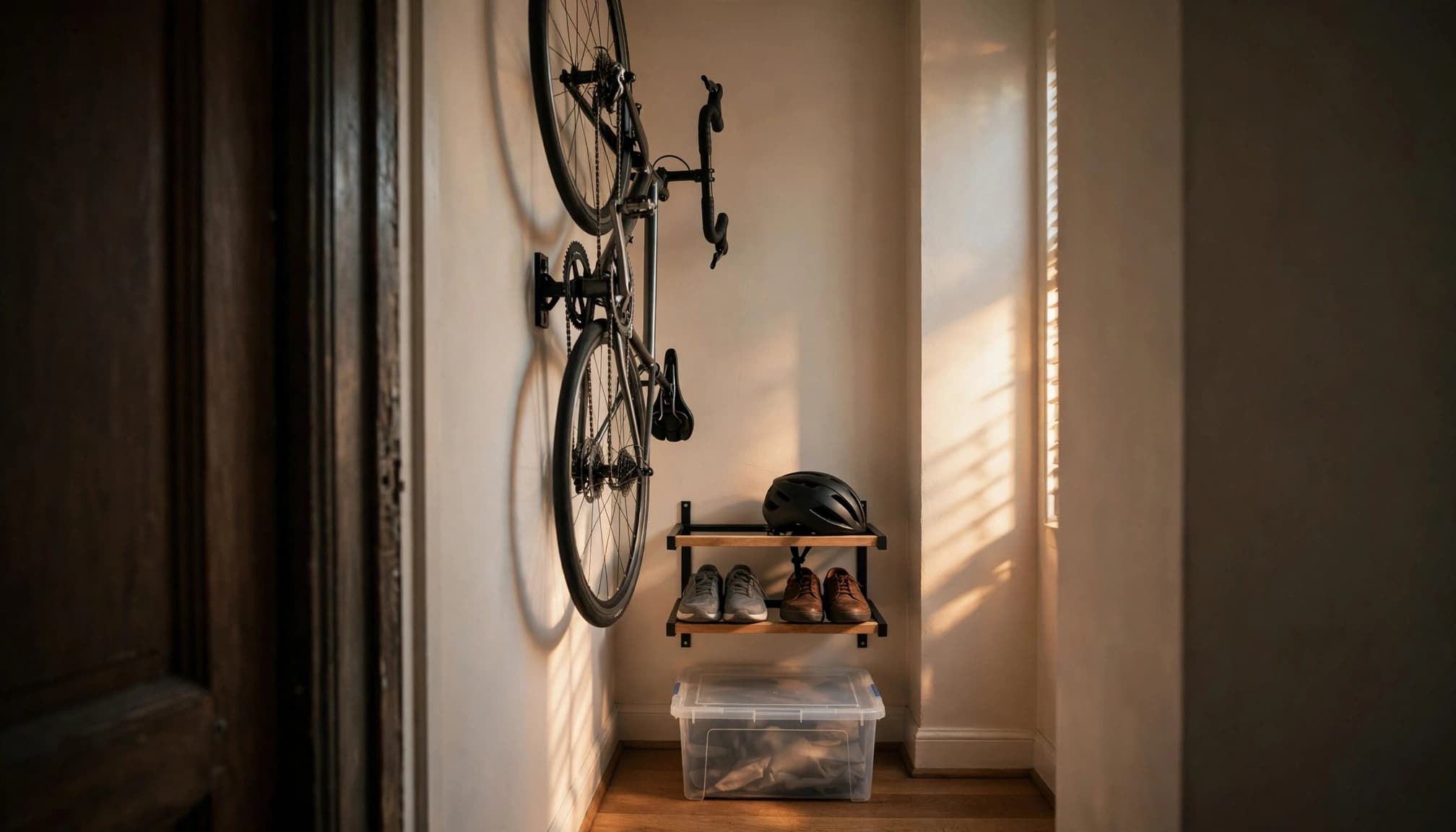
Choose a Renter-Friendly Setup
A freestanding rack makes bike storage possible without drilling, but it still needs a suitable, clear floor spot. Position it against a wall where pedals and handlebars won’t catch clothing.
Some floor-to-ceiling racks use pressure fittings. These need compatible surfaces and installation exactly as directed. Freestanding furniture may also require anchoring, so don’t assume every no-drill-looking product suits your rental.
Our renter-friendly storage without drilling guide covers removable options for lighter belongings.
Use Wall and Ceiling Space Safely
Vertical bike hooks and wall-mounted racks free up floor space, but the bicycle still projects into the room. Leave clearance beside doors and furniture.
Choose storage hooks or track attachments rated for the loaded equipment and wall construction. Adhesive utility hooks aren’t a substitute for structural bike mounts.
Slat walls offer adjustable hooks for mixed equipment. Ceiling storage suits bulky, occasional-use items only when the structure, mounting hardware, and lifting access are safe. In a low-ceilinged apartment, a reachable wall rack is usually more practical.
Keep Balls, Bats, and Small Accessories Together
Choose Open Storage for Frequent Use
A mesh bag contains balls without hiding them. A narrow ball rack keeps a few loose balls contained and easy to reach. Triple mesh storage bins with four rolling wheels let you separate equipment by sport, child, or item. They work best when there’s a parking spot that doesn’t block a walkway.
For larger collections, Net World Sports’ portable ball carts include a 40-ball option. The Portable Ball Cage and Equipment Cart costs $212.49 and has lockable caster wheels. That capacity is more suited to team equipment than a few household balls.
Match Wall Holders to the Equipment
Ball claws use protective three-prong or two-prong grips for soccer balls, footballs, basketballs, and volleyballs. Install them on a suitable flat surface with the required fixings. Several individually mounted balls can consume a surprising amount of wall space.
Elfa utility tracks accept mesh bags and small tool holders for tennis racquets, baseball bats, rakes, and shovels. Choose only the attachments your apartment needs.
A divided bin is often simpler for mixed accessories. Give gloves, pumps, and loose straps separate compartments so they don’t disappear beneath larger equipment.
What Should You Spend on a Sports Storage Rack?
Start with containers you already own. Buying a dedicated rack makes sense when it replaces several awkward storage spots, but garage storage products may be too large for an apartment. Our small space storage guide for everyday tasks explains how to measure a footprint before anything new comes home.
LTMATE’s sports organizer rack has a 265-pound capacity and combines ball storage with a golf bag organizer. At $178.49, it also provides bat holders. Its mixed-sport layout suits a household with several equipment types, provided the footprint fits.
Heavy-duty steel sports racks are another option. Designs with two wire-grid bins, removable dividers, a plastic bottom liner, and four removable hooks keep loose accessories contained. Compare usable compartment sizes, access, and anchoring requirements rather than choosing by total capacity alone.
A rack’s weight rating doesn’t tell you whether it fits your apartment, supports each shelf equally, or stands safely without anchoring. Check its dimensions, since a rack designed for a garage floor may exceed your available footprint.
Team equipment needs a different budget. AAE’s field-event carriers and racks include an aluminum vaulting pole tree at $525 and a goal post carrier at $11,550. Those are facility-scale solutions, not useful benchmarks for household storage.
Two DIY Storage Ideas Worth Adapting
These small-scale DIY sports equipment storage projects are ideas to adapt to your space, not universal plans.
Build a Freestanding Wooden Bike Rack
A basic rack can use two-by-fours for a stable base and 45-degree dividers to separate bike positions. You’ll need suitable lumber, screws, a drill, measuring tools, and a saw, or pre-cut timber.
Set spacing around the widest fork and tire combination. Seven-inch spacing is one example, not a universal measurement. Account for pedals and handlebars, too.
Sand exposed edges and test stability before use. This design suits a utility area better than a narrow apartment hallway.
Add a Bungee Ball Retainer
A four-foot adjustable bungee cord is one of several DIY storage solutions for a suitable utility shelf, where it can form a flexible retainer. Multiple cords spaced about six inches apart allow balls to pass through while limiting rolling.
Use secure attachment points and keep cords away from faces and children’s play areas. Don’t stretch cords beyond their intended limits.
A mesh bag is the simpler choice when you don’t already have suitable shelving.
Protect and Rotate Seasonal Sports Gear
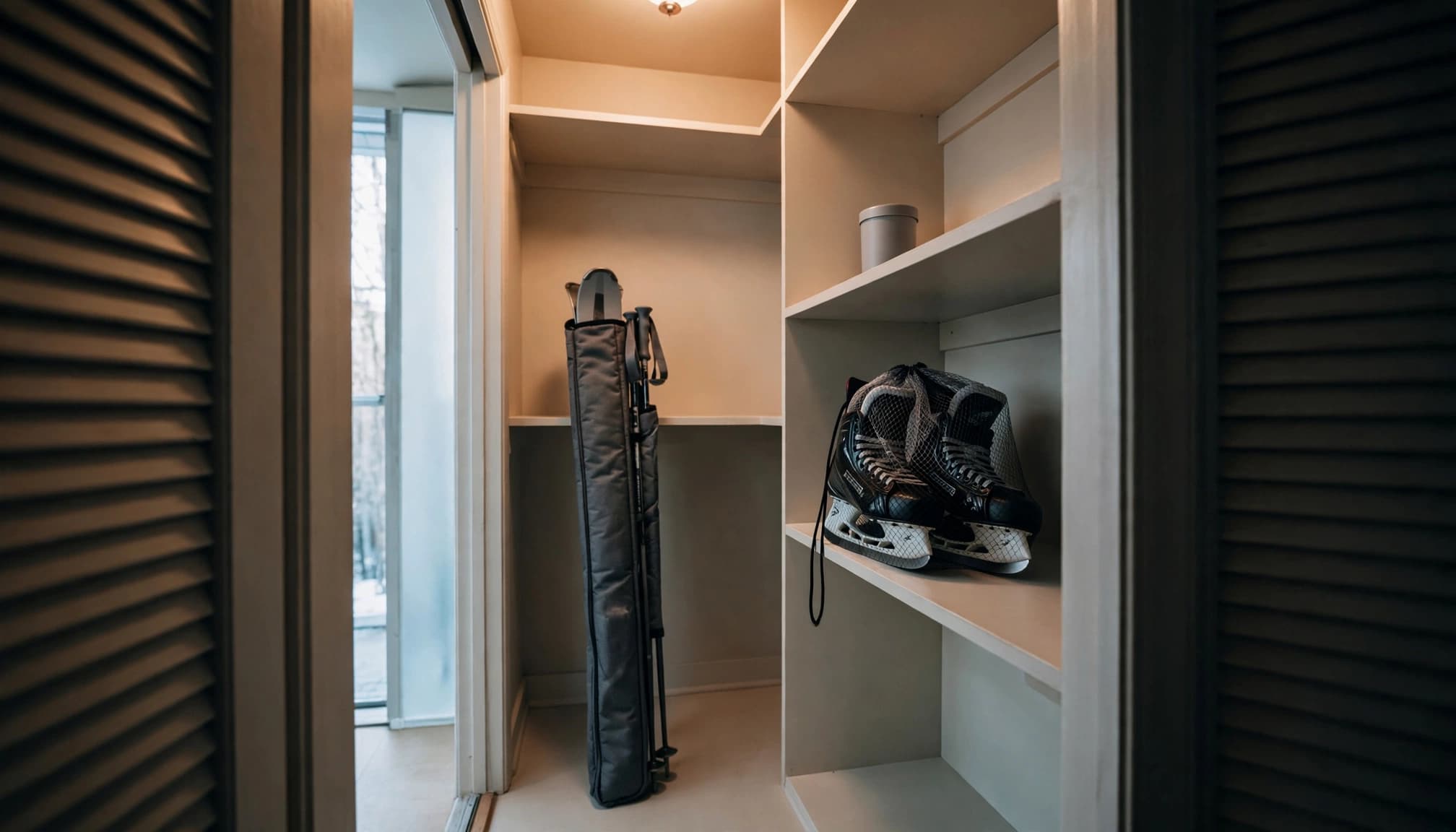
Clean equipment and let it dry completely before covering or packing it away. Trapped moisture can cause moisture damage, rust, and mold, especially inside closed bags.
Keep skis, snowboards, and hockey equipment in a dry, climate-controlled space. That can be an interior apartment closet, rather than a separate storage unit. Gore Mountain’s ski and snowboard storage guidance recommends temperature-controlled storage away from heat, sunlight, and moisture.
Use moisture absorbers where needed, but don’t rely on them to fix a persistently damp cupboard. Leave sweaty protective equipment open to dry before packing it away.
Use protective covers or padded cases for expensive gear, and keep it in a dry space. Support bikes, skis, snowboards, and kayaks off the floor where a suitable rack fits. Kayaks need appropriate padded supports, not improvised hooks.
For small closet storage, rotate seasonal gear into less accessible areas when your activities change. Our seasonal closet storage guide offers ways to separate current essentials and off-season belongings.
Frequently Asked Questions
Where Should You Store Dumbbells in a Small Apartment?
Keep dumbbells low on a stable rack rated for their weight, or in a suitable floor-level tray. Avoid high shelves and lightweight rolling carts.
Protect flooring with an appropriate mat and leave room to pick weights up safely. Don’t concentrate a large collection on furniture that wasn’t designed for it. For unusually heavy collections, get advice on floor loading before choosing a location.
Can You Keep Sports Equipment in a Shared Hallway?
Keep equipment inside your apartment or in designated building storage. Shared hallways and stairs need to remain clear for access and escape.
A slim organizer inside your own entrance is preferable to leaving a bike or equipment bag outside your door. If indoor space is limited, reduce duplicate equipment before adding overflow storage.
Make Your Storage Easy to Use
Useful sports equipment storage gives each item an accessible home without taking over your apartment. Start with the gear that causes the most daily clutter, then choose one organizer that fits.
Keep walking routes clear, follow mounting requirements, and store seasonal equipment clean and dry. A setup you can use easily after practice is easier to maintain.